Your brakes do more work than almost any other system on your vehicle, and in Northeast Ohio, the conditions they face are about as demanding as it gets. Between potholes that jar your suspension, road salt that corrodes metal components, stop-and-go traffic through Cleveland and Akron, and winter driving that puts every safety system to the test, your brakes take a beating year round.
At Rad Air Complete Car Care, brake work is one of the most common services we perform across all 11 of our locations. And after decades of inspecting, repairing, and replacing brake systems on vehicles driven in this region, we have learned that the difference between a brake job that lasts and one that does not comes down to how thoroughly the work is done.
This is not a simple pad swap and send you on your way situation. Brake performance depends on the pads, the rotors, the calipers, the fluid, the hardware, and even the condition of your suspension. When we do brakes at Rad Air, we look at all of it.
Most brake problems give you warning signs well before they become dangerous, but you have to know what to listen and feel for.
The most recognizable symptom is noise. A high-pitched squeal during light braking usually means your brake pads are getting thin. Many pads have a small metal tab called a wear indicator that is designed to contact the rotor when the pad material is nearly gone. That squeal is intentional. It is your brakes asking for service.
Grinding is more serious. If you hear a harsh, metallic grinding sound when you press the brake pedal, the pad material is likely worn through completely, and metal is contacting metal. At that point, you are not just wearing out pads. You are damaging rotors, which increases the scope and cost of the repair.
A pulsation or vibration in the brake pedal when stopping, especially from highway speeds, usually indicates warped or uneven rotors. This happens over time as heat builds up unevenly across the rotor surface. It can also happen after aggressive braking, towing, or driving through standing water immediately after hard braking.
Pulling to one side during braking can point to a caliper that is sticking, a collapsed brake hose, or uneven pad wear. If the vehicle drifts left or right when you apply the brakes, that is not a minor issue. It affects stopping distance and control.
A soft or spongy brake pedal, or one that sinks further toward the floor than it used to, often indicates air in the brake lines or a fluid issue. In some cases it can mean a failing master cylinder. Either way, reduced pedal firmness means reduced braking power, and that should be addressed immediately.
A customer came into our Seven Hills shop last fall after noticing a slight grinding noise during her morning commute on Broadview Road. She had planned to wait another few weeks, but decided to come in after the noise got louder following a heavy rain. When we pulled the wheels, the inner pad on the front left was completely gone, and the rotor had deep scoring. The outer pad still had material, which is why it did not grind all the time. We replaced the pads, resurfaced the rotors where possible, and replaced the one that was too far gone. Two more weeks of driving and that rotor would have needed replacement on both sides.
If you have ever wondered why your brakes seem to wear out faster here than the manufacturer estimate suggests, local conditions are the reason.
Stop-and-go driving is the biggest factor. Every time you press the brake pedal, friction converts motion into heat, and that wears the pads and rotors. Drivers navigating rush hour traffic through Cleveland, Garfield Heights, or along I-480 are applying their brakes hundreds of times per commute. That daily cycle adds up quickly.
Road salt is another contributor. Salt accelerates corrosion on rotors, brake lines, and caliper hardware. Over time, corroded slide pins can seize, causing the caliper to drag or apply unevenly. Corroded brake lines can develop weak spots that eventually leak. We see this frequently at our Wickliffe and Westlake locations, where vehicles are exposed to heavy salt application on lakefront routes and highway ramps.
Potholes and rough roads affect brakes indirectly by damaging suspension components. A worn strut or a loose control arm can change how weight transfers during braking, which affects pad wear patterns. Drivers who commute on I-77 through the Akron area or on secondary roads around Medina and Smithville often deal with road surfaces that stress the entire front end, including the brake system.
Hilly terrain also increases brake use. If your daily route includes elevation changes, you are braking more on descents than a driver on flat roads. That consistent extra heat shortens pad and rotor life.
At Rad Air, we do not treat brake repair as a parts-only job. Every brake service includes a full evaluation of the system, because replacing pads without checking everything else can leave you with new parts that wear unevenly or a problem that was never actually fixed.
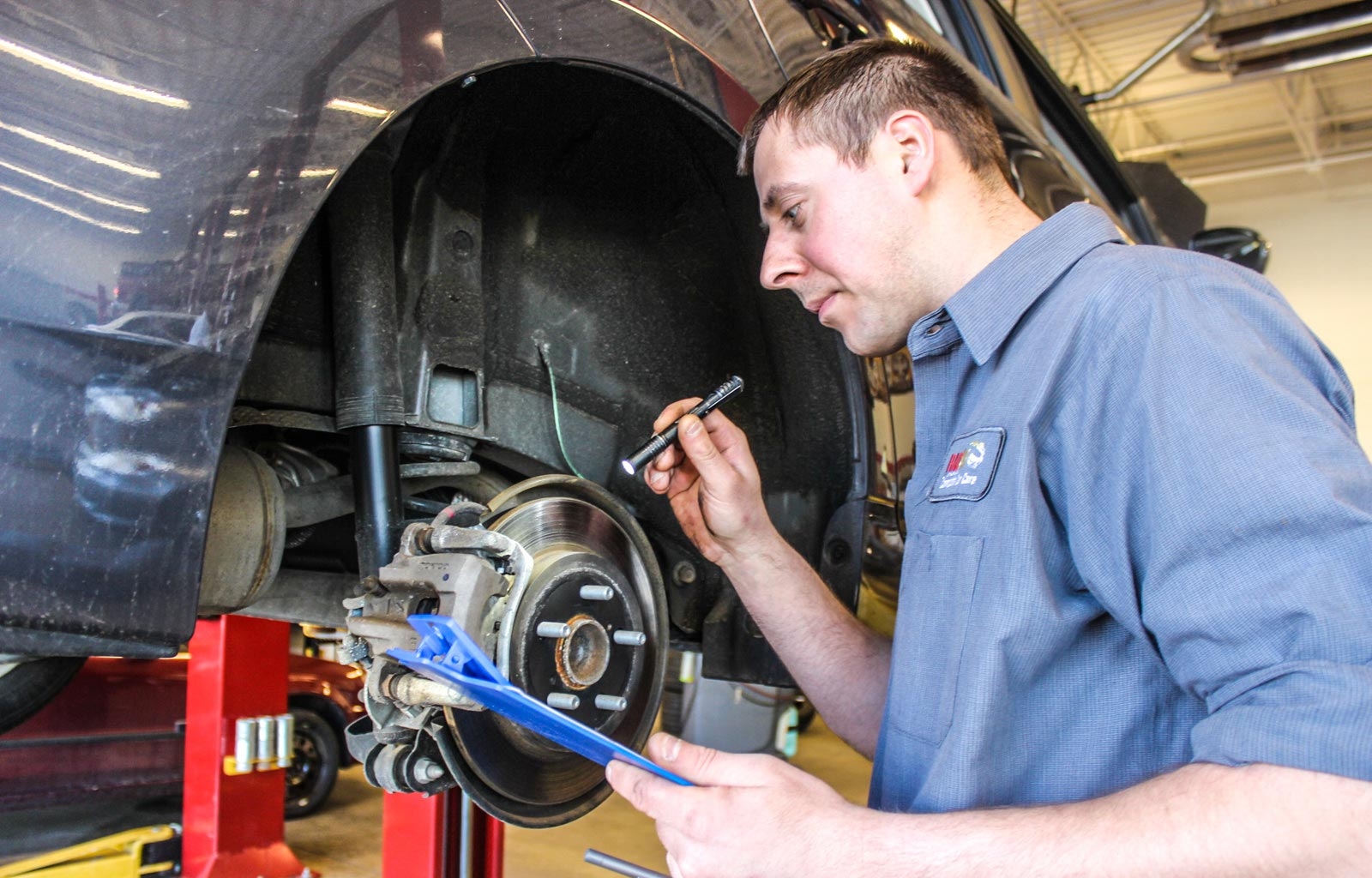
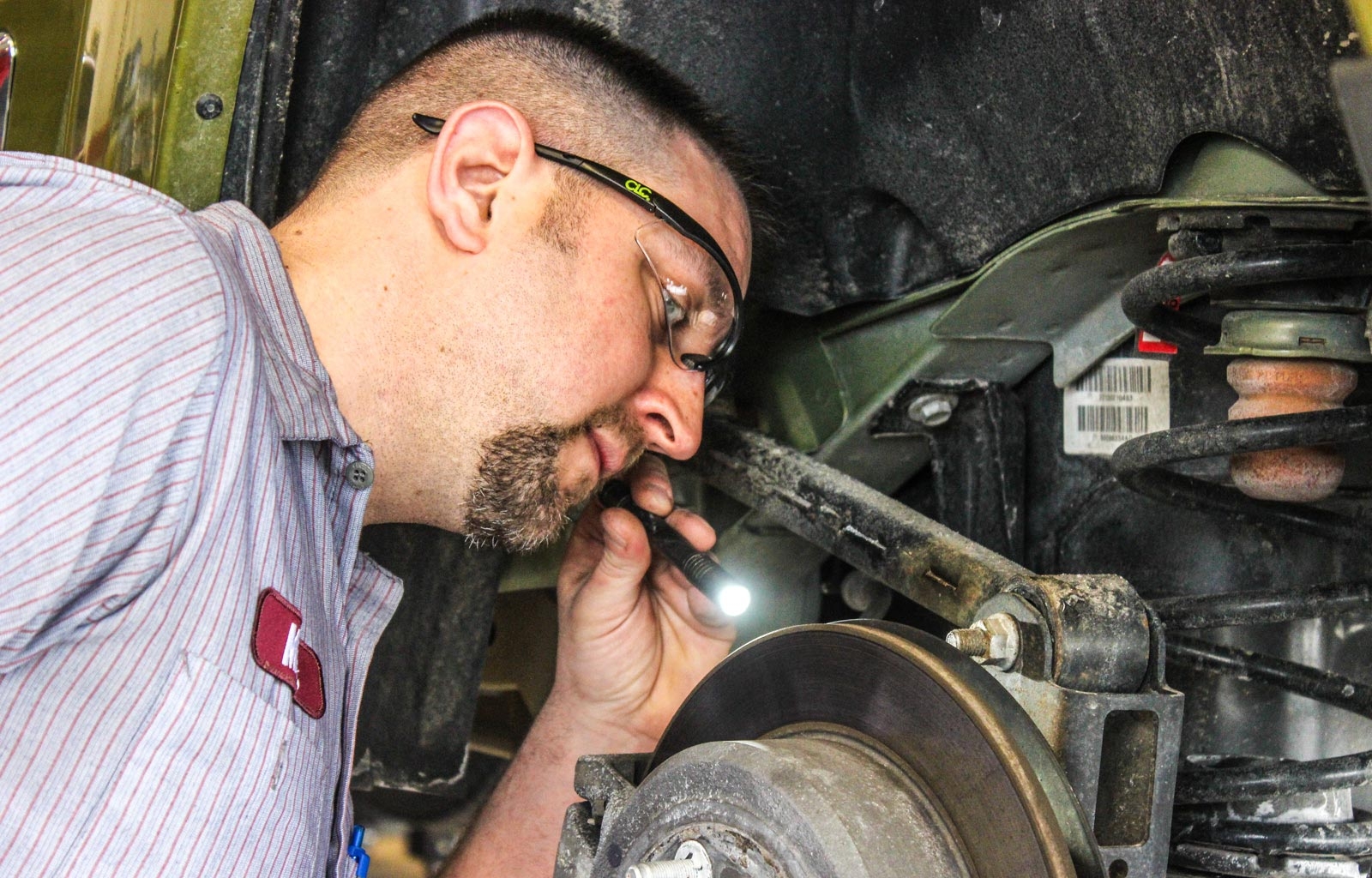
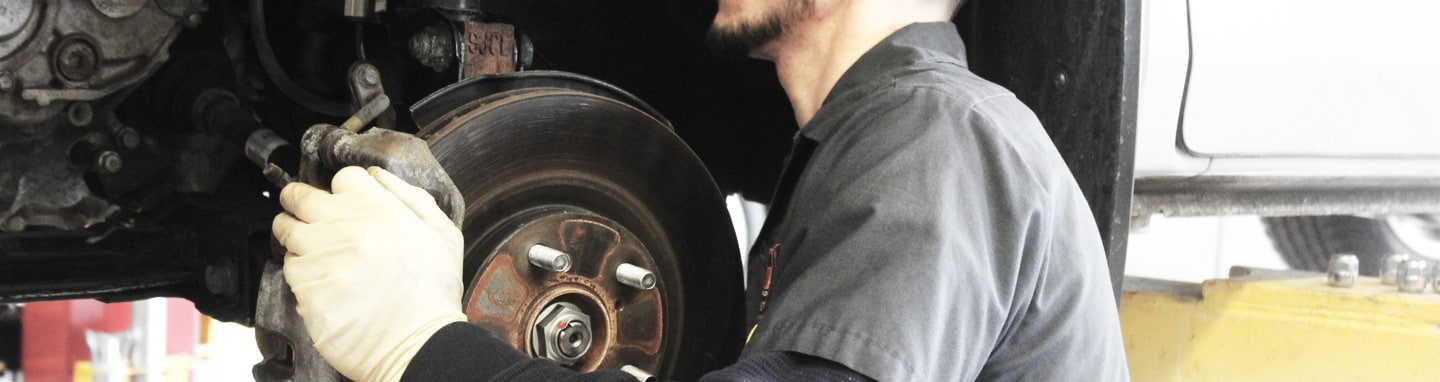
When a vehicle comes in for brake work, our technicians remove the wheels and inspect the full brake assembly. That includes measuring pad thickness and checking for uneven wear, measuring rotor thickness and runout to determine if they can be resurfaced or need replacement, inspecting calipers and slide pins for proper movement and lubrication, checking brake hoses for cracking or swelling, evaluating brake fluid condition and level, and inspecting the hardware that holds the pads in place.
Hardware matters more than most people realize. The clips and shims that position the pads in the caliper bracket can corrode, bend, or lose their spring tension. When that happens, the pads can shift or drag, creating noise, uneven wear, or reduced performance. We replace hardware when necessary and lubricate slide pins to ensure the caliper moves freely.
We also check the suspension during brake work. If a ball joint is worn or a strut is leaking, that affects how the vehicle handles under braking. Catching those issues during a brake job prevents repeat visits and ensures your new brakes perform the way they should.
A driver came into our Strongsville location last winter for a brake noise complaint. Another shop had replaced his front pads six months earlier. When we pulled the wheels, we found the slide pins were seized and the caliper was not retracting properly, which had already worn through half the new pad on the inner side. The previous shop had replaced the pads but never cleaned or lubricated the caliper hardware. We freed up the slide pins, replaced the pads again, and the brakes worked correctly. That is the difference between changing parts and actually servicing the system.
Brake fluid is a hydraulic fluid that transfers the force from your foot on the pedal to the calipers at each wheel. It operates under extreme pressure and temperature, and over time it absorbs moisture from the air. Moisture-contaminated brake fluid has a lower boiling point, which means it can vaporize under heavy braking and create a spongy pedal or reduced stopping power.
Most manufacturers recommend brake fluid replacement every two to three years or 30,000 miles. In Northeast Ohio, where moisture and temperature swings are constant, staying on schedule is especially important. At Rad Air, we test brake fluid condition during inspections and recommend service when the moisture content reaches a level that compromises performance.
If you hear noise, feel pulsation, notice the pedal feels different, or see a brake warning light on your dashboard, bring the vehicle in. Those are all signs that something in the system needs attention, and catching it early almost always means a simpler, less expensive repair.
Even if you are not experiencing symptoms, having your brakes inspected once a year is a smart habit for Northeast Ohio drivers. Our technicians check brakes during many routine services, but a dedicated brake inspection gives us the time to measure everything precisely and give you a clear picture of how much life is left in your pads, rotors, and fluid.
Rad Air Complete Car Care provides brake diagnosis and repair at all 11 of our Northeast Ohio locations: Akron, Cleveland, Fairlawn, Garfield Heights, Medina, Parma Heights, Seven Hills, Smithville, Strongsville, Westlake, and Wickliffe. Every location follows the same thorough inspection process, and our technicians will explain what they find before recommending any work.
Schedule your brake service at radair.com/schedule-online or find your nearest location at radair.com/locations. We will check the whole system and give you a straight answer on what needs to be done.
How do I know if my brakes are safe to drive on?
If you hear grinding, feel a significant pulsation, or the brake pedal sinks further than normal, have the vehicle inspected before driving further. Squealing alone does not mean the brakes are unsafe, but it does mean service should be scheduled soon. When in doubt, bring it in and let us measure the pads and rotors.
How often should brakes be inspected in Northeast Ohio?
At least once a year, and more frequently if you drive in heavy stop-and-go traffic or notice any changes in braking feel or sound. Rad Air checks brakes during many routine service visits, but a dedicated inspection provides the most complete evaluation.
Can brake pads wear unevenly?
Yes. Uneven pad wear is common and usually indicates a caliper, slide pin, or hardware issue. If only one pad is wearing faster than the other on the same axle, the caliper may not be retracting properly. This is something Rad Air checks during every brake service.
Does Rad Air replace brake fluid?
Yes. We test brake fluid condition and recommend replacement when moisture content reaches a level that affects performance. Most vehicles benefit from a brake fluid service every two to three years, and Rad Air handles this at all 11 locations.
Should I replace rotors every time I replace pads?
Not necessarily. If the rotors are within manufacturer thickness and runout specifications, they can often be resurfaced and reused. If they are too thin, warped beyond correction, or heavily scored, replacement is the right call. Our technicians measure before making that recommendation.
Pads, rotors, calipers, hardware, and fluid — a proper brake job looks at all of it. Rad Air Complete Car Care will inspect the full system and give you a straight answer at any of our 11 Northeast Ohio locations.