Most drivers notice it for the first time in a parking lot. You cut the wheel hard to pull into a space, and something clicks. Or you hear a low grind as you roll through a slow turn at an intersection. Maybe it is a whine from under the hood that gets louder the more you turn the wheel. Whatever the sound is, your car is telling you something specific, and the type of noise narrows down the cause faster than any scan tool.
I have been diagnosing steering and suspension problems at Rad Air Complete Car Care for over two decades. When a customer tells me their car makes noise when turning, my first question is always the same: describe the sound. That single detail points me toward a component before I even pop the hood. Clicking usually means CV joints. Grinding usually means brakes. Whining usually means power steering. Creaking usually means suspension. Not always, but often enough that the sound itself is the best starting point.
Here is what each of those noises actually means, what causes them, and how to know when it is time to bring the vehicle in.
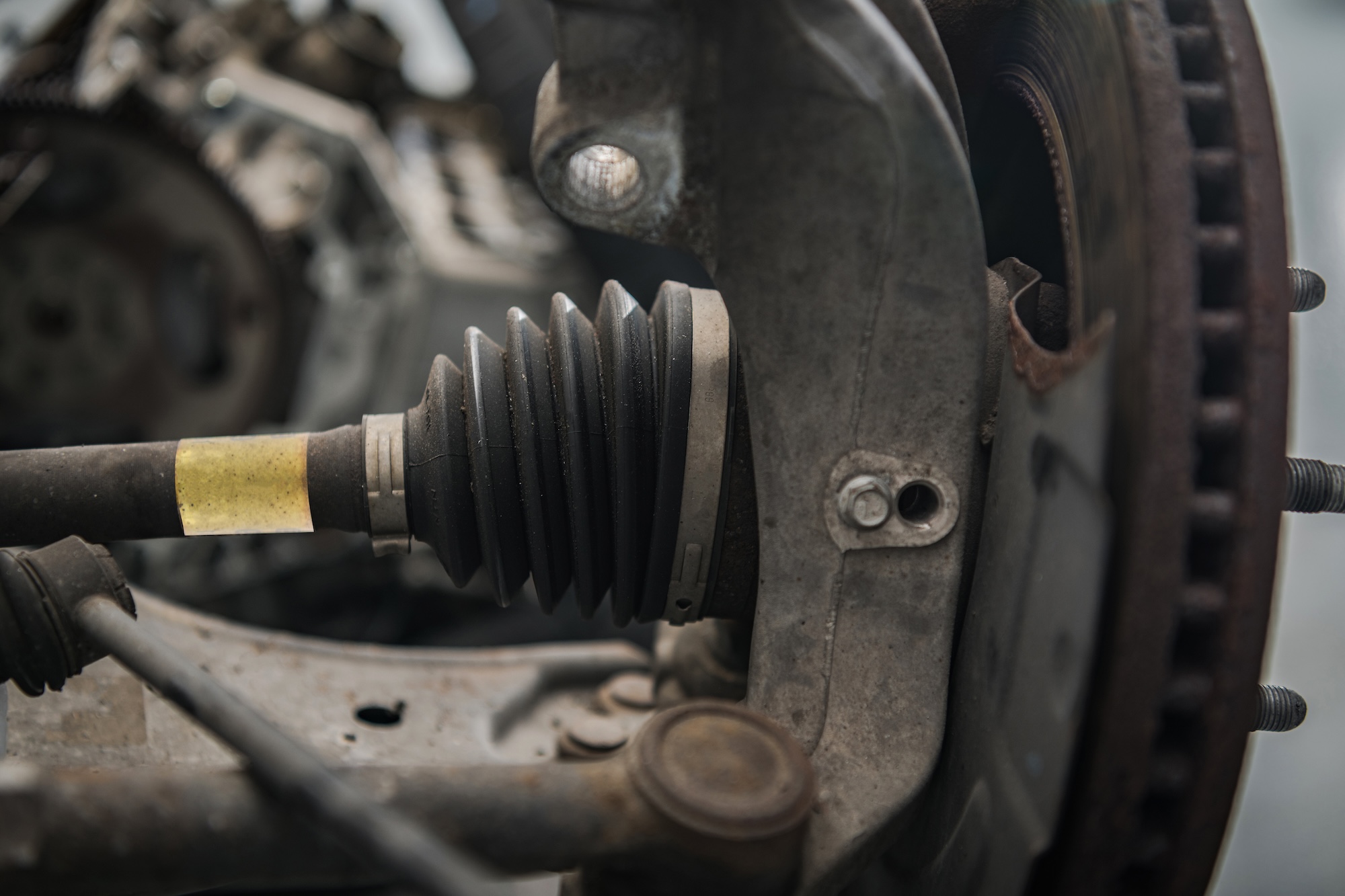
A rhythmic clicking or popping sound during turns is one of the most common complaints we hear, and it almost always traces back to a worn CV joint. CV joints, short for constant velocity joints, are the connections that transfer power from your transmission to your wheels while allowing the wheels to turn. The outer CV joint takes the most abuse because it operates at the sharpest angles during turns.
The clicking typically starts during slow, sharp turns like pulling out of a parking space or making a U-turn. In the early stages, you might only hear it when turning in one direction. As the joint wears further, the clicking gets louder, happens in both directions, and eventually shows up during gentle highway lane changes.
What is actually happening inside the joint is straightforward. The CV joint is a ball-and-socket mechanism packed with grease and sealed inside a rubber boot. When that boot cracks or tears, which is common on vehicles driven over rough Northeast Ohio roads, the grease leaks out and road grit gets in. The contaminated joint wears rapidly, and the clicking sound is the worn internal components losing their precise fit.
A customer at our Akron shop came in last spring after hearing a faint click during left turns in his apartment complex. He assumed it was something minor. When we put the vehicle on the lift, the driver-side outer CV boot had been torn for a while. The joint was already dry and contaminated. We replaced the axle assembly before the joint could fail completely. A CV joint that locks up or separates in traffic creates an immediate loss of power to that wheel. Catching it at the clicking stage is the difference between a scheduled repair and a tow truck.
Cold weather can make a clicking noise when turning more noticeable because the remaining grease thickens, but a worn joint clicks regardless of temperature. If you hear rhythmic clicking during turns, the joint is already past the point where re-greasing will help. It needs to be inspected.
A harsh, metallic grinding sound when you turn is almost always brake related. When brake pads wear through the friction material completely, the steel backing plate makes direct contact with the rotor. That metal-on-metal contact produces the grinding sound, and it becomes more noticeable during turns because of how weight transfers across the front axle.
When you turn left, more weight loads onto the right front wheel. When you turn right, the left front wheel takes the load. If one side has a pad that is more worn than the other, you will hear the grinding noise when turning the steering wheel in the direction that loads that wheel. This is why some drivers initially think the problem is intermittent or only happens in parking lots. It is not intermittent. It is loading one side harder than the other.
We had a customer at our Seven Hills shop who came in describing a grinding sound only when turning right into her driveway. She figured something was rubbing against the wheel. When we pulled the front wheels, the inner pad on the left front was completely gone and the rotor had deep scoring. The outer pad still had material left, which is why the grinding was not constant during straight-line braking. Two more weeks of driving and both rotors on that axle would have needed full replacement instead of just the one.
Grinding during turns is not something to monitor. It means your braking surface is already compromised and your stopping distance is affected. If you hear a grinding noise when turning your steering wheel, bring the vehicle in before the damage spreads to components that are more expensive to replace.
A whine that increases in pitch or volume the harder you turn the wheel is typically coming from the power steering system. The power steering pump generates hydraulic pressure that assists your steering input, and it needs a specific fluid level to operate correctly. When the fluid drops, the pump draws in air along with the remaining fluid, and that creates the characteristic whining sound.
Low power steering fluid almost always means a leak. The rack, pump, hoses, and connections can all develop leaks over time. Topping off the fluid without finding the leak is a temporary fix. The level will drop again, the whining noise when turning will return, and every time the pump runs low on fluid, it accelerates wear on the pump itself.
A customer at our Medina location brought in an older Chevy Impala with a whine that had been getting louder for a few weeks. He had been adding power steering fluid every few days to keep the noise down. When we inspected the system, the high-pressure line had a slow seep at one of the crimp fittings. The pump was still functioning, but it had been running partially starved of fluid for long enough that it was starting to develop internal wear. We replaced the leaking line and the fluid, and the whine was gone. Had he waited much longer, the pump itself would have needed replacement too.
Not all vehicles have hydraulic power steering. Many newer cars use electric power steering, which does not have fluid. Whining or groaning noises on those systems may indicate a motor or sensor issue that requires different diagnostic procedures. Our technicians identify which system your vehicle has before starting any diagnosis.
A creaking or groaning sound when you turn, especially at low speed, often comes from the suspension rather than the steering system itself. Ball joints, control arm bushings, strut mounts, and sway bar links all allow movement while supporting the vehicle’s weight, and when they wear, they produce creaking and popping sounds under load.
This type of noise tends to be worst during slow maneuvers because the suspension components are under the most stress when the vehicle is moving slowly and the wheels are turned significantly. Highway driving may mask the sound because the loads are distributed differently at speed.
A creaking noise when turning the steering wheel is common in Northeast Ohio because of what our roads do to suspension components. Potholes, frost heaves, and rough pavement all accelerate bushing wear. Drivers who commute through Cleveland, Garfield Heights, or along I-480 put their suspension through thousands of load cycles every week. We see worn ball joints and dried-out bushings on vehicles with surprisingly low mileage simply because of the road conditions they face daily.
Suspension creaks are not always urgent, but they should not be ignored for months. A worn ball joint can eventually separate, which causes a sudden loss of steering control. A failed strut mount can change your alignment angles and chew through tires. Having the noise inspected and identified gives you the information to decide when to address it.
Turning noises can overlap and mislead. A CV joint click can sound like a loose heat shield. Brake grinding can mimic a stone caught between the backing plate and rotor. A tire with internal belt damage can produce a rhythmic noise that sounds like it is coming from the steering system. The only way to know for sure is a proper inspection.
At Rad Air Complete Car Care, our diagnostic process starts with a road test. We replicate the exact conditions where the noise occurs because tight parking lot turns stress different components than highway lane changes. Slow-speed turns with braking highlight brake-related sounds. Constant-speed turns with no braking isolate drivetrain and steering noise. We document exactly when and how the sound appears because that information is more valuable than any code reader.
From there, we inspect visually and by measurement. CV boots get checked for tears and grease leakage. Brake pads get measured for remaining thickness. Power steering fluid gets checked for level, color, and condition. Suspension components get tested for play and looseness. For sounds that are hard to pinpoint, we use electronic stethoscopes to isolate the exact source. The goal is always to find the actual cause so the repair fixes the real problem.
All 11 Rad Air locations across Northeast Ohio follow the same diagnostic process: Akron, Cleveland, Fairlawn, Garfield Heights, Medina, Parma Heights, Seven Hills, Smithville, Strongsville, Westlake, and Wickliffe. Every shop has the equipment and experience to track down turning noises and explain what they find in plain terms.
Schedule your evaluation at radair.com/schedule-online or find your nearest location at radair.com/locations. We will find what is making the noise and give you a straight answer on what it needs.
How urgent is a clicking noise when turning?
CV joint clicking does not require you to stop driving immediately, but it does need attention soon. The longer a worn joint operates, the closer it gets to complete failure. Schedule an inspection within a few days of first noticing the sound. Do not wait for it to get louder.
Can a grinding noise when turning damage other parts?
Yes. Once brake pad material is gone and metal is contacting the rotor, the rotor gets scored with every rotation. What starts as a pad replacement becomes a rotor replacement if it goes too long. The caliper can also sustain damage in severe cases. Address grinding promptly to keep the repair on the smaller end.
Why does the whining only happen when I turn the wheel?
Power steering whine increases during turns because the pump works harder to generate the pressure needed to assist your steering input. The whine is caused by low fluid allowing air into the system. It may be faintly present while driving straight, but turning amplifies it because of the increased demand on the pump.
Could the noise be coming from more than one source?
It happens. We occasionally find vehicles with both a worn CV joint and a brake issue contributing to noise during turns. A worn suspension bushing and a low power steering fluid level can both produce sounds during the same maneuver. That is why a thorough inspection matters more than guessing based on the sound alone.
Does cold weather cause turning noises?
Cold temperatures thicken lubricants in CV joints and power steering systems, which can make marginal components more noticeable. Suspension bushings also stiffen in cold weather and may creak more than they do in warm months. If a noise appears in cold weather and fades when things warm up, the component is still wearing. It just needs more deterioration before the noise becomes constant year round. Bring it in while the problem is still in the early stages.
Clicking, grinding, whining, or creaking — the sound tells us where to look. Rad Air Complete Car Care will road test, inspect, and give you a straight answer at any of our 11 Northeast Ohio locations.